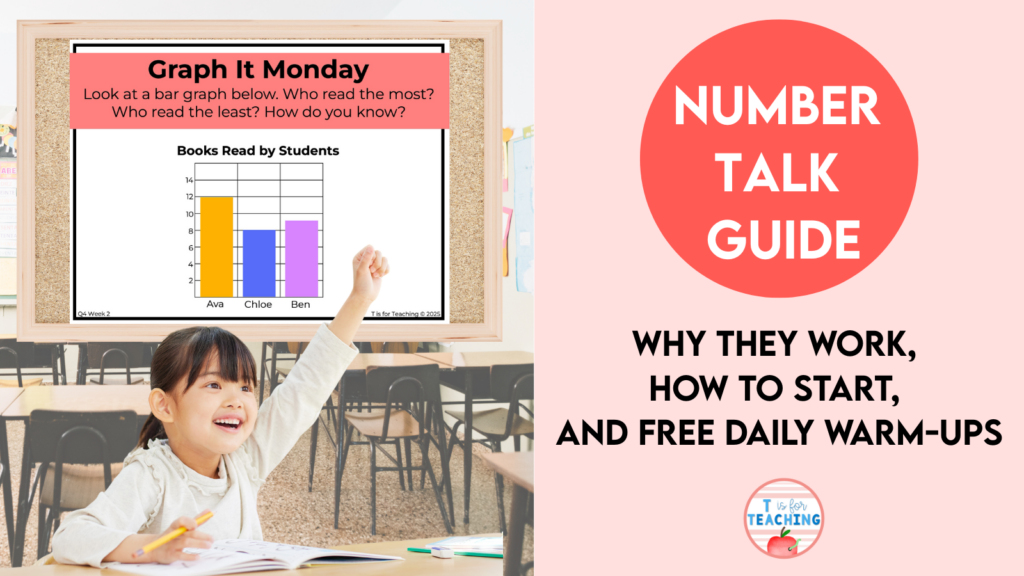
If you’ve ever wanted your 2nd graders to feel more confident sharing strategies, discussing their thinking out loud, and solving problems mentally—then Number Talks might just become your new favorite daily routine. These short, intentional math conversations build number sense, flexibility, and confidence—all in about 5–10 minutes a day.
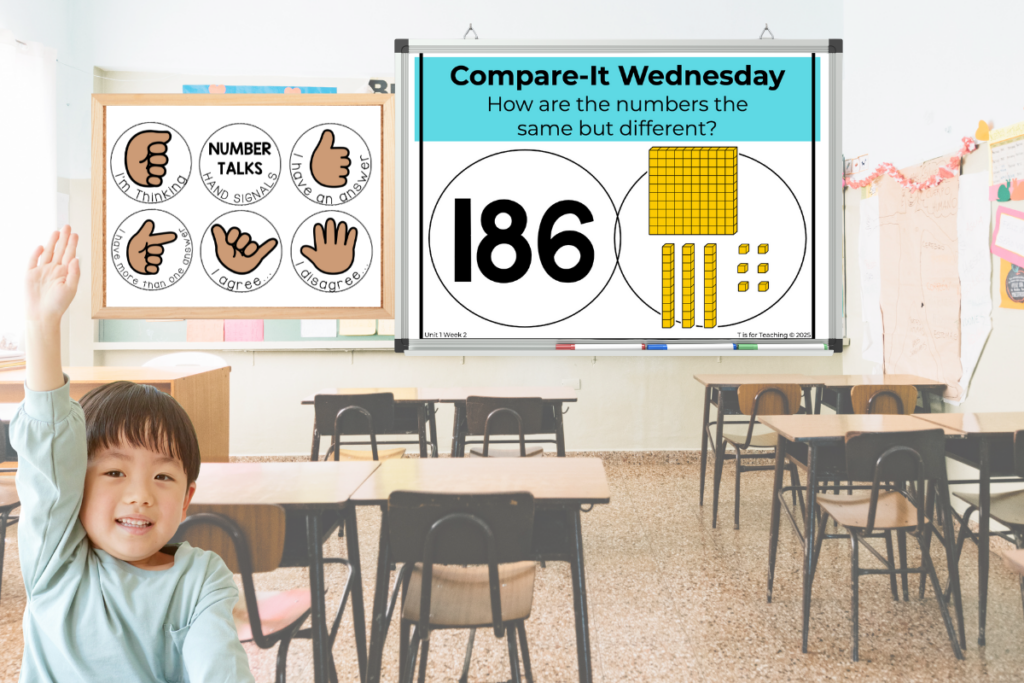
I couldn’t imagine starting my math block any other way. I love that Number Talks can gently introduce new concepts in a low-pressure way, review previously taught skills to keep learning fresh, and offer open-ended prompts that make differentiation feel natural and manageable.
I use Number Talks because I’ve seen what they do. Students start noticing patterns, trying new strategies, and explaining their thinking in ways that carry into all areas of math. And the best part? It doesn’t take a whole new curriculum—just consistency, structure, and a willingness to listen.
Here’s how I run Number Talks, why they work, and how you can get started as soon as tomorrow.
What Are Number Talks?
Number Talks are brief, daily routines. You pose a problem (on a whiteboard or smart board), students solve it mentally, and they use simple hand signals to show when they’re ready. Students share answers—and more importantly—share strategies.
As the teacher, you record what students say (not your own method), then highlight efficient or creative strategies.
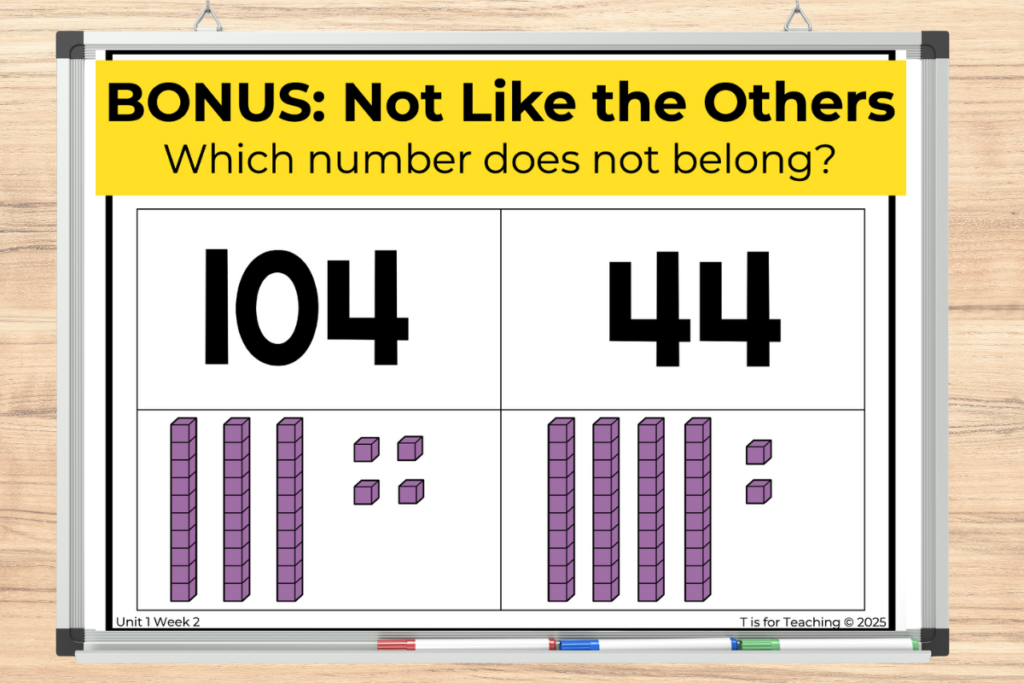
Students learn from one another. They see that there’s more than one way to reach the same answer. Over time, they build flexible number sense instead of relying on memorized steps.
Why Number Talks Work
One thing I love about Number Talks is how simple they feel in the moment—yet how much they actually do for students. There’s plenty of math-education research behind them, but honestly, the benefits are easy to see right in your own classroom.
Here are a few reasons they’re so effective:
• They help students truly understand numbers.
Instead of memorizing steps, students make sense of numbers by building them, breaking them apart, and noticing patterns. Research points to this kind of sense-making as the foundation for long-term fluency—and you can watch it happen during your daily warm-ups.
• Students naturally shift to more efficient strategies.
With regular practice, students move from counting strategies to flexible thinking using place value, making tens, and decomposing numbers. It’s a gradual shift that happens because students are exposed to many ways of thinking every day.
• Math talk builds confidence.
When students explain their ideas out loud (or even just compare their thinking to a peer’s), they begin to see themselves as mathematicians. This kind of discussion is something math experts encourage — and it’s amazing how quickly it changes the atmosphere in your room.
• Mistakes become part of learning.
Students learn that mistakes aren’t a big deal — they’re actually helpful. Number Talks create space for risk-taking, trying new strategies, and refining ideas without pressure.
• You build a math community.
This is the part I love most. Number Talks bring your class together around shared routines, respectful listening, and celebrating multiple ways of solving a problem.
It’s quick, it’s simple, and over time, it transforms the way students see math.
How to Launch Number Talks in Your 2nd Grade Classroom
Ready to start? Download my free number talks sample kit here to give them a try.
Here’s what to do in the first 1–2 weeks:
1. Teach hand signals and routines
Use simple hand signals for: “I have an answer,” “I have another strategy,” “I need more time,” “I agree,” and “I’d like to share.” This keeps discussion orderly and gives students space to think.
Set expectations: we listen, respect each other, celebrate multiple ways of thinking, mistakes are learning, and everyone gets a turn.
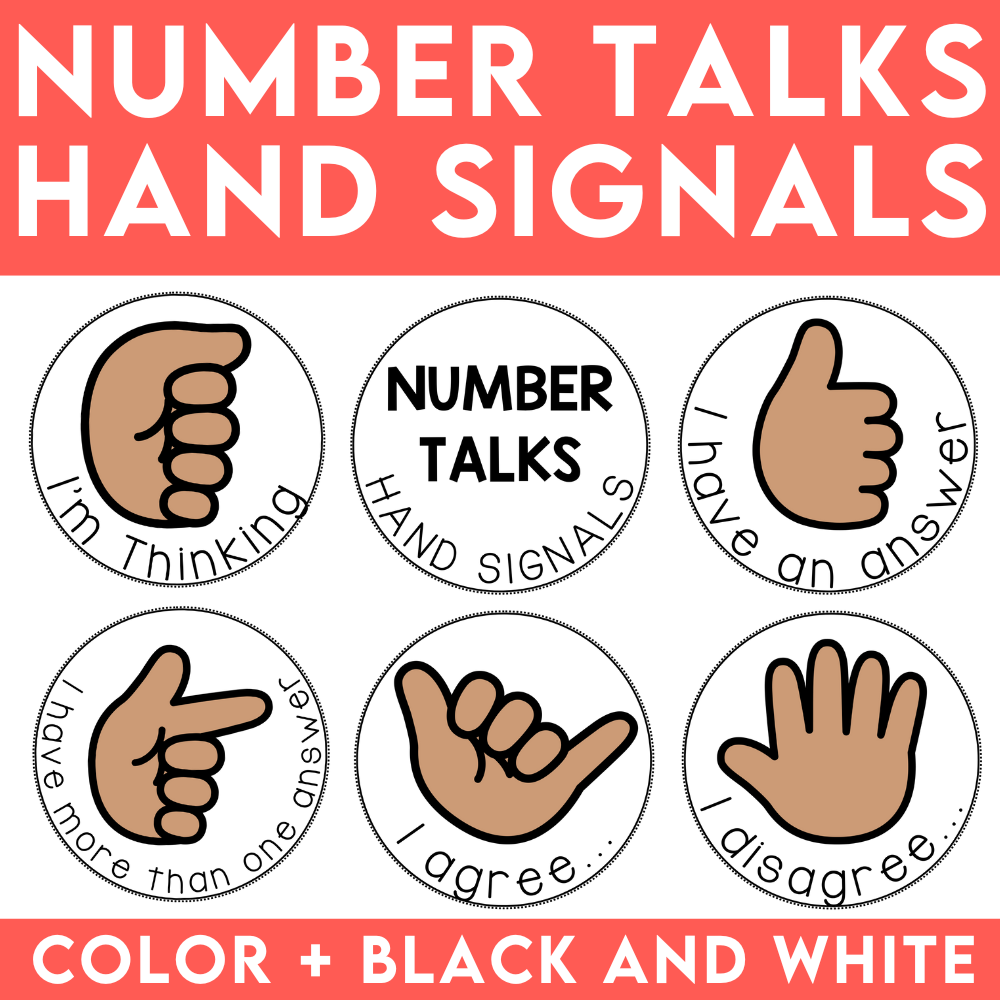
Hand signals streamline discussions so students can focus on thinking — not waiting for their turn. They help:
-
Reduce pressure
-
Encourage participation from all students
-
Keep discussions organized
-
Support classroom management
With clear routines and respect for each student’s thinking, math class becomes a safe space for sharing, experimenting, and learning from mistakes.
2. Use sentence starters
Prompts like:
-
“I solved it by …”
-
“I noticed …”
-
“Another way could be …”
Help students put their thinking into words — a powerful step for building reasoning.
You can download FREE sentence starters in my Number Talk Starter Kit below:
3. Start simply, build gradually
Begin with small numbers, friendly problems, predictable routines. As students get comfortable, increase complexity, integrate place value, money, time, measurement — and tie in quarterly themes.
4. Make it consistent
It doesn’t need to be long — 5–10 minutes is enough. The magic comes from consistency and routine.
How I Structure a Full Year — Quarter by Quarter
Here’s the progression I use (and what I recommend for 2nd grade) based on this free year-long scope and sequence.
Quarter 1: Number Sense & Place Value
-
Focus on representing numbers, decomposing them, comparing, making tens, understanding place value to 1,000.
-
Problems like: “How many ways can you make 47?” or “Which is greater — 392 or 329?”
-
Purpose: build a strong foundation for mental math and number sense.
Quarter 2: Addition & Subtraction Fluency
-
Use place value reasoning for addition/subtraction, make-tens, doubles/near doubles, mental strategies.
-
Problems like: “37 + 25,” “49 + 36 — how did you make this easier?”, “43 – 19.”
-
Purpose: grow fluency and build strategies students can use independently.
Quarter 3: Real-World Math — Measurement, Time, Money & Geometry
-
Introduce measurement comparisons, telling time, counting coins, shape attributes, partitioning, spatial reasoning — and spiral review of prior skills.
-
Problems like: “How many ways can you make 65¢?”, “What time is shown?”, “Which shape doesn’t belong?”
-
Purpose: build real-world reasoning, vocabulary, and flexible thinking.
Quarter 4: Spiral Review & End-of-Year Mastery
-
Mix of operations, multi-step reasoning, larger numbers, mental math, and revisiting time/money/measurement/geometry.
-
Encourage students to use their favorite strategies from the year.
-
Purpose: solidify number sense, build confidence, prepare for next grade.
Try Number Talks Now(Free!)
Want to test Number Talks right away? I’ve set up a FREE 5-Day Sample you can try with your class tomorrow. It includes:
- 5 days of open-ended Number Talk prompts + a bonus!
- Printable discussion prompt posters to support math talk all year
- A simple routine you can use during the first week of school or anytime you want to strengthen number sense
👉 Download your free Number Talks sample here
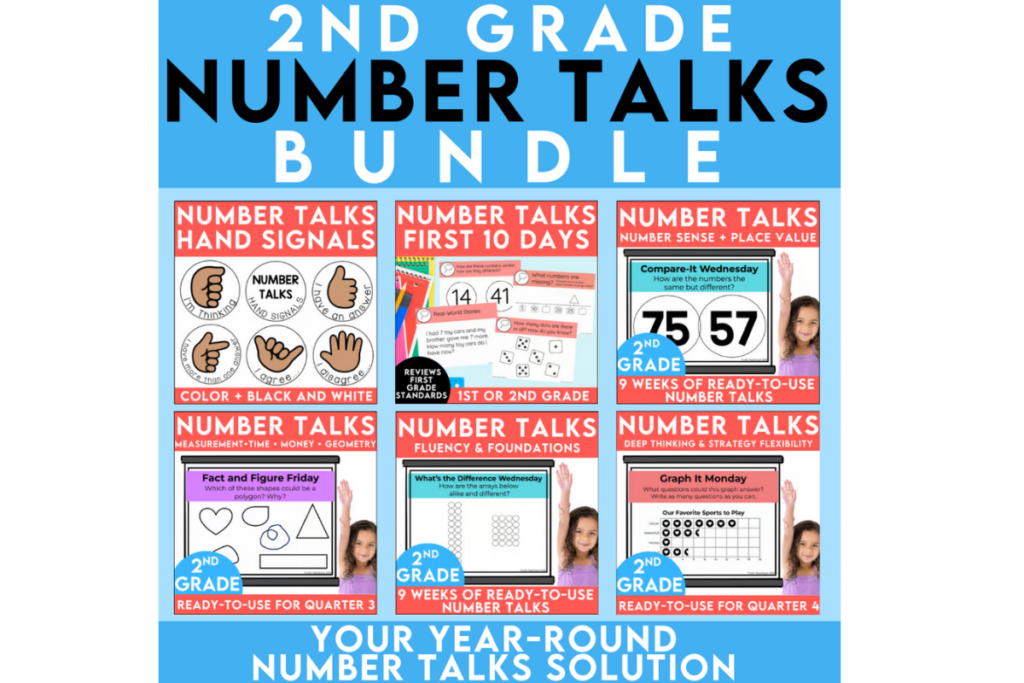
If the sample feels like a great fit, you can explore the full Year-Long Bundle (Quarters 1–4 + Hand Signal Posters) and get everything you need to run Number Talks all year long.
Final Thoughts
Number Talks are small — but powerful. In just a few minutes a day, students build number sense, reasoning, confidence, and ownership of their learning.
If you try them, I’d love to hear how it goes. Which strategies do your students pick? Which prompts spark the best discussions?
If you’re ready to make Number Talks part of your daily routine, I’ve put everything together in one easy-to-use bundle. It includes:
-
The First 10 Days of Number Talks
-
All four quarterly sets
-
Number Talk Hand Signal Posters
Everything you need for the entire year.